
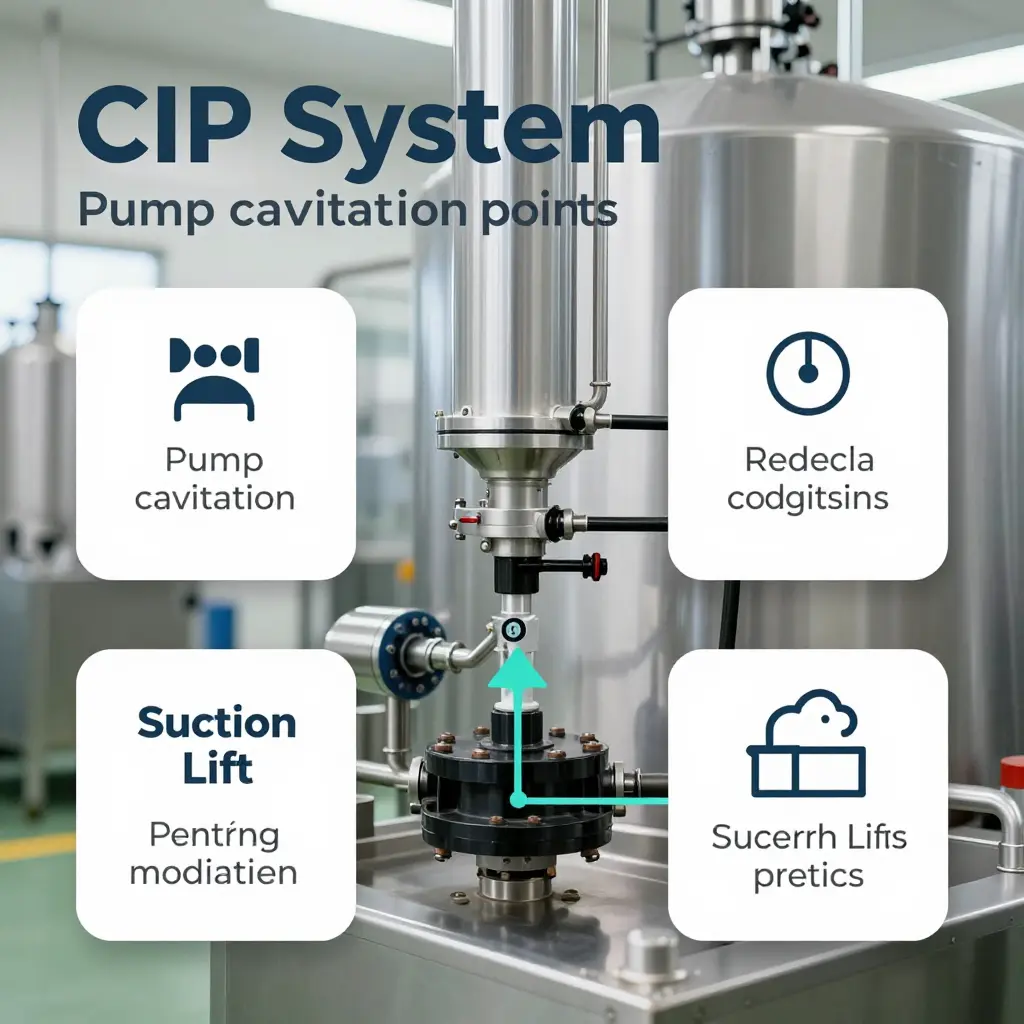
CIP pump cavitation in food plants: why suction lift sizing matters more than impeller trim
Clean-in-place (CIP) systems circulate caustic, acid, and rinse solutions through tanks, lines, valves, and spray balls on a fixed schedule. When a CIP pump cavitates, that schedule breaks down, and with it the cleaning performance your food safety plan depends on. The easiest fix is usually to trim the impeller, on the assumption that flow or pressure is mismatched. On most CIP circuits, that treats a symptom rather than the cause.
The constraint usually sits on the suction side. Net positive suction head available (NPSHa) is set by suction lift, line length, fittings, and fluid temperature, and when it runs short the pump is pushed toward its cavitation limit. Impeller trim shifts the pump curve on the discharge end; it does little for the suction energy at the impeller eye, which is where the vapor bubbles form and collapse.
For the engineers and operations staff who own the wash cycle, the payoff is concrete: steadier CIP flow, consistent chemical contact times, and fewer unplanned stoppages caused by pump damage or failed washes. What follows covers why suction conditions decide whether a pump cavitates, how to check suction lift sizing against your duty points, and the narrow cases where trimming an impeller actually helps.
Cavitation in CIP Pumps: Start With the Mechanism
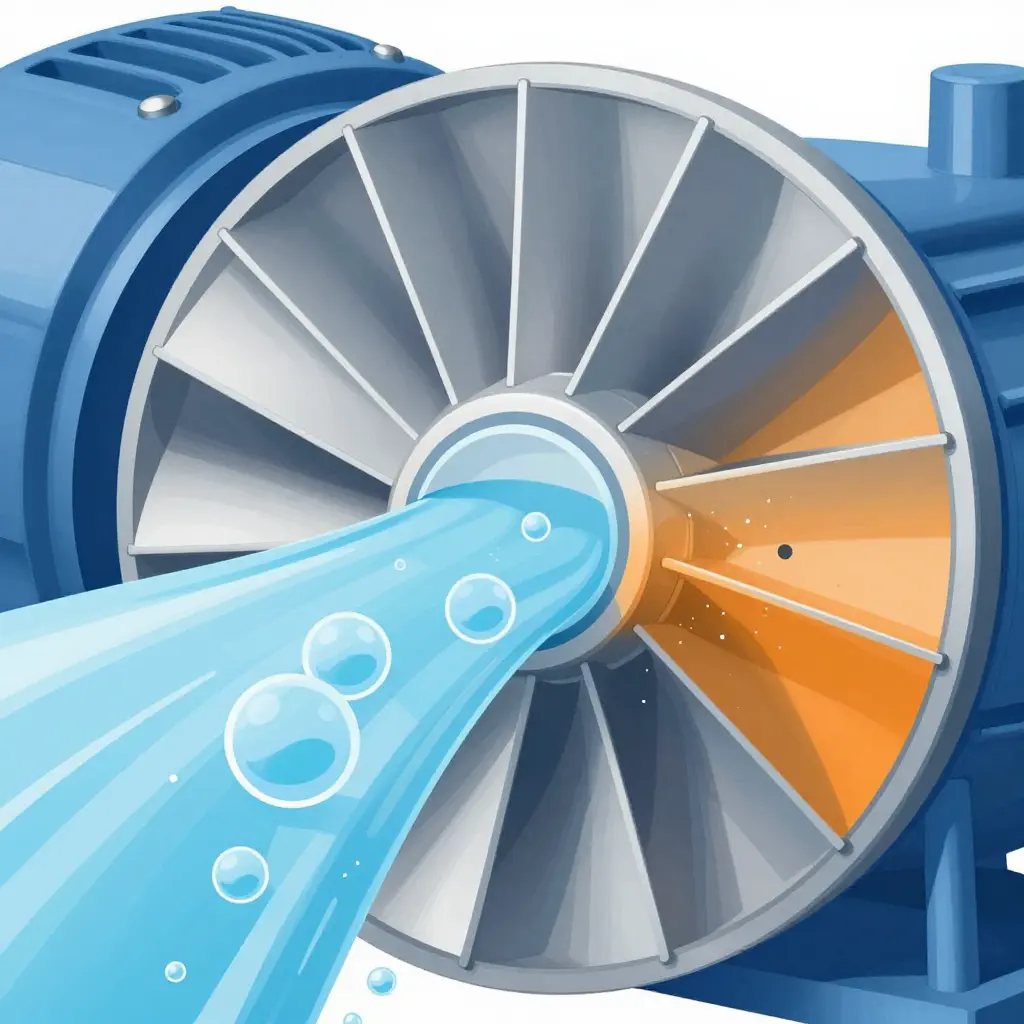
CIP pump cavitation happens when the local static pressure inside the pump drops below the liquid’s vapor pressure. At that point the liquid flashes to vapor rather than continuing to flow. Bubbles form at the impeller eye, travel with the flow, and collapse the moment they reach a higher-pressure zone. The shaft keeps turning, but the pump is no longer moving liquid reliably; it is fighting a cloud of vapor.
The sequence is short:
- Pressure drop below vapor pressure – suction lift, friction losses, and a hot suction line pull local pressure down.
- Bubble formation – the fluid flashes to vapor, creating a compressible pocket at the impeller inlet.
- Bubble collapse – bubbles implode against the vane surface, releasing micro-jets that hammer the metal.
Why CIP Fluids Are Especially Vulnerable
The difference in a food plant is that the cleaning fluids are hot by design. Water, caustic, acid, and sanitizer all have a vapor pressure that climbs steeply with temperature.
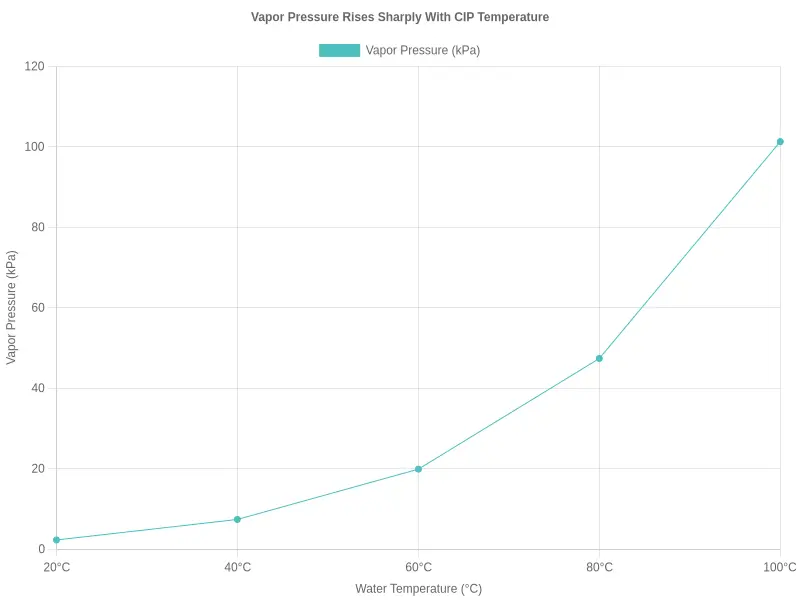
As the temperature rises, the margin between inlet pressure and vapor pressure shrinks quickly:
- Hot wash water near 60-80 C can carry a vapor pressure many times higher than cold rinse water.
- Caustic and acid solutions add density, raising suction-side losses.
- Sanitizer dosing and thermostatic control can push the temperature even higher at the pump inlet.
At a fixed suction lift, hotter fluid leaves less usable NPSH available. A pump that ran clean on cold rinse water can quietly starve on the hot wash cycle.
What cavitation actually looks like
Cavitation shows up on the pump and in the wash result:
- Impeller erosion – pitted, sponge-like marks on the vane surfaces and a rough, eroded impeller eye.
- Flow instability – fluctuating flow and discharge pressure, which weakens spray-ball coverage.
- Noisy operation – a distinctive crackling or gravel-in-the-pump sound.
- Incomplete cleaning coverage – unstable flow starves spray balls and piping, leaving soil residue and biofilm behind, a real food safety risk.
A pressure-margin problem, not a trim problem
Teams often answer cavitation by trimming or swapping the impeller, hoping to “tune” the pump out of trouble. A trim changes the performance curve, not the suction margin. When NPSHa sits below NPSH required, the fix is on the suction side: shorter lifts, larger inlet lines, lower fluid temperature, and less friction loss. Treat cavitation as a pressure-margin problem, and your food plant sanitation routine will hold up far better over the long run.
Why Suction Lift Sizing Sets NPSHa and Prevents Cavitation
When a CIP pump starts rattling, losing head, or chewing through impellers, the impeller is rarely the culprit. The problem usually sits upstream in the suction line, where the available Net Positive Suction Head (NPSHa) has quietly fallen below what the pump needs. Cavitation begins the instant NPSHa drops under the pump’s required Net Positive Suction Head (NPSHr), because the liquid flashes into vapor bubbles that collapse against the impeller. Suction lift sizing is what sets NPSHa, which makes it the more direct lever against cavitation.
NPSHa vs. NPSHr: The Two Numbers That Decide Cavitation
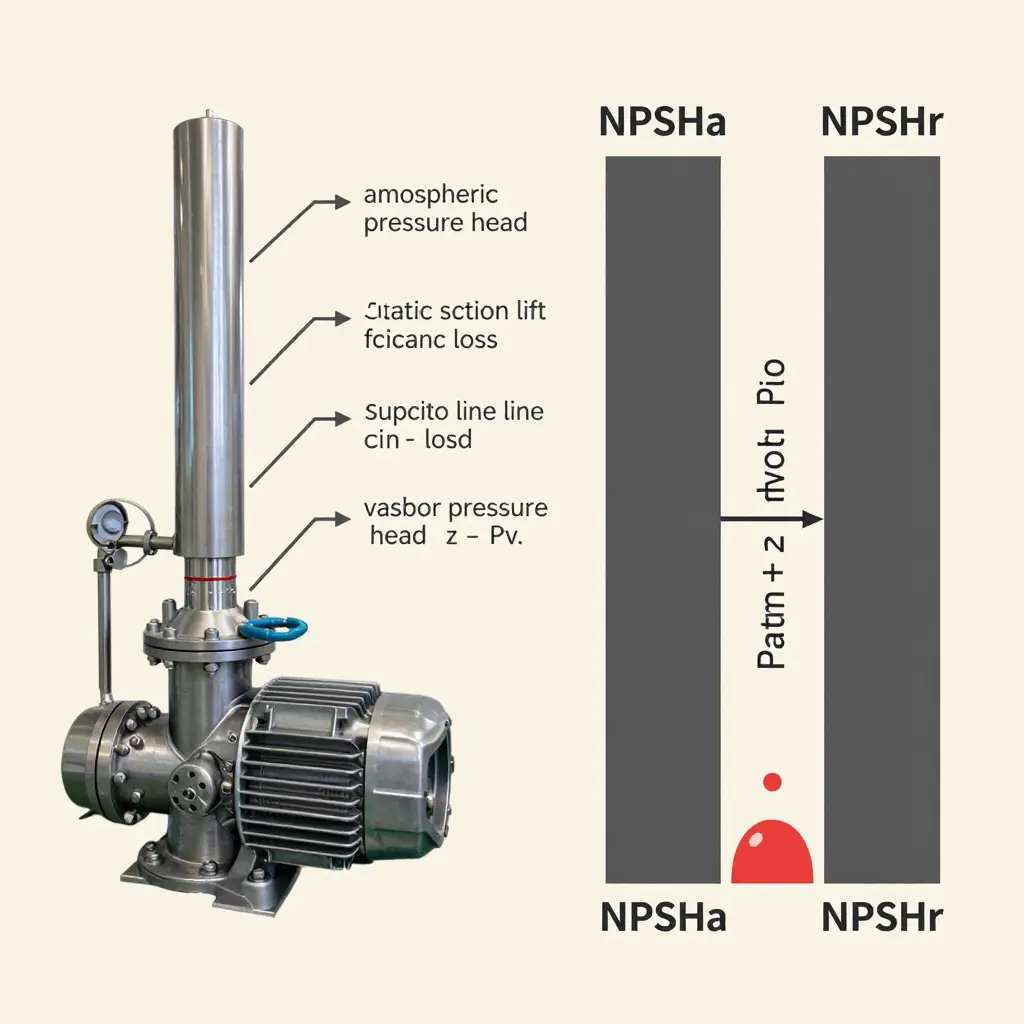
NPSHr belongs to the pump. For a given flow, speed, and impeller, it is the minimum suction head needed to avoid significant head loss, usually quoted at the 3% head-drop threshold. NPSHa is what the piping and tank arrangement actually deliver to the inlet, and it changes with every installation detail. Avoiding cavitation comes down to keeping NPSHa comfortably above NPSHr.
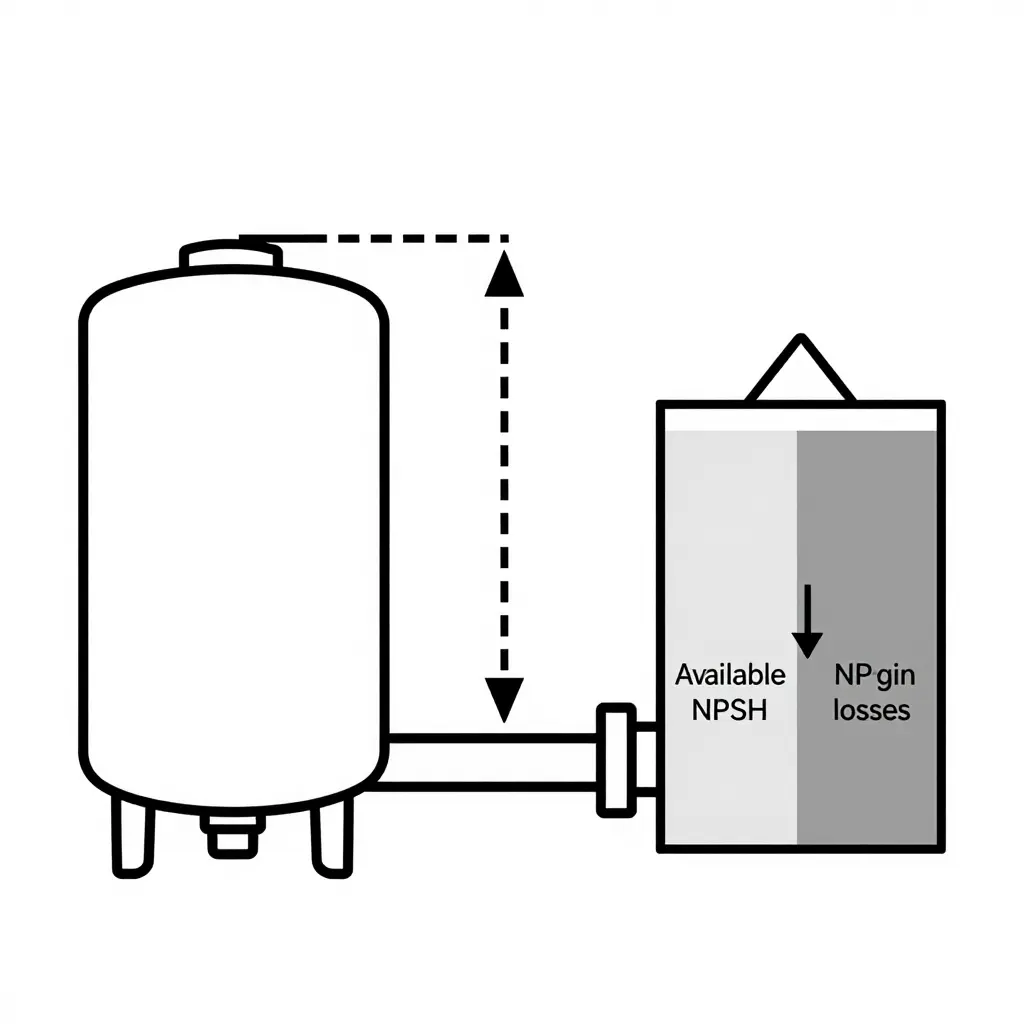
NPSHa behaves like a budget that four factors draw down:
NPSHa = (Atmospheric pressure head) + (Static suction head) – (Suction line friction losses) – (Vapor pressure head)
What Erodes NPSHa in a Real Food Plant
Every term matters, and suction lift sizing controls the largest one.
| Factor | Effect on NPSHa | Why it matters on the floor |
|---|---|---|
| Suction lift | Reduces it ~1 m per 1 m of lift | Largest, most controllable loss |
| Suction line friction | Reduces it as flow, length, bends rise | Undersized pipe spikes losses |
| Fluid temperature | Reduces it as vapor pressure climbs | Hot CIP caustic is worst case |
| Site elevation | Reduces it as atmospheric pressure falls | High-altitude plants run lean |
The effect shows up quickly at CIP temperatures. 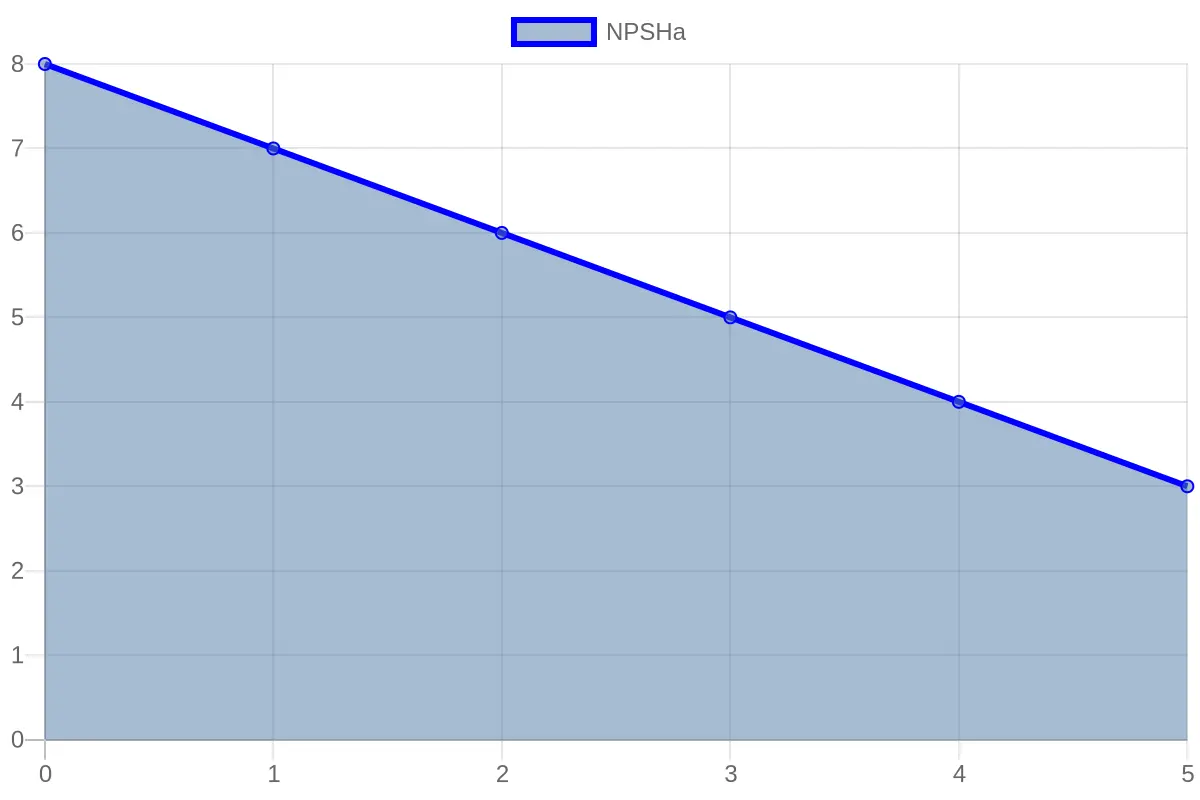
A 180 F caustic wash carries a vapor pressure head that consumes much of the available budget before the pump moves any liquid. Add three or four meters of suction lift and the friction losses of an undersized, elbow-heavy line, and NPSHa can fall toward zero. Trimming the impeller barely moves NPSHr, and it does nothing to restore the suction head the system delivers.
The NPSH Margin Is Your Safety Buffer
The gap between the two numbers is the NPSH margin, and it is the figure to design around. A common target is NPSHa at least 1 m, or 10-30%, above NPSHr at the worst-case flow and temperature, so ordinary variation does not push the pump into cavitation.
The Verdict
Undersized suction lift sits at the center of most cavitation troubleshooting. Because lift, friction, temperature, and elevation all subtract from NPSHa, and lift is the largest and most controllable term, the order is clear: fix the suction side first, then fine-tune the impeller. Size the suction line generously, keep the pump flooded or low, verify the margin at the maximum CIP temperature, and cavitation stops being a recurring maintenance item.
| Factor | Adjusting Suction Lift Sizing | Adjusting Impeller Trim | Effect on CIP Pump Cavitation Risk |
|---|---|---|---|
| NPSHa impact | Raises available NPSH by improving suction-side conditions | No change to NPSHa; only lowers required NPSHr | Strong reduction; tackles the root cause |
| Effect on flow rate | Slightly increases or stabilizes CIP flow rate | Reduces flow, sometimes below CIP cleaning target | Lowers risk by cutting hydraulic demand |
| Effect on discharge pressure | Minimal change at the discharge nozzle | Directly reduces discharge pressure | Indirect, symptom-level benefit only |
| Sensitivity to fluid temperature | High; hot CIP water sharply lowers NPSHa | Low; trim ignores temperature-driven vapor pressure | Sizing resolves temperature-related cavitation |
| Required hardware change | Reconfigure piping, tank height, or suction line | Swap or machine the impeller only | Varies; trim invites recurring cavitation |
Why Impeller Trim Can’t Fix CIP Pump Cavitation
Trimming moves the duty point, not the suction side
Impeller trim is the practice of machining down the outer diameter of a centrifugal pump impeller to reduce its performance. A smaller impeller develops less head and moves less flow at the same motor speed.
When a CIP pump runs too far out on its curve, pushing excess flow or over-pressurizing a spray header, trimming is the cheapest correction available. Pull the impeller, turn it down on a lathe, and the pump “settles down.” No re-piping, no new skid, no capital request – which is exactly why trim becomes the default fix.
Why trim does not help the suction side
The effect is comparable to throttling the discharge: it restricts what leaves the pump and never changes what the suction can deliver. If the suction line cannot push liquid into the impeller eye fast enough, restricting the outlet does nothing for inflow.
The NPSH margin stays negative
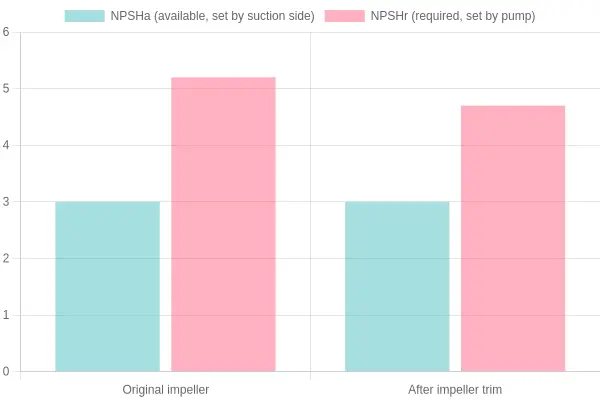
Trim redraws the pump’s head-flow curve and moves its NPSHr curve only slightly, because the impeller eye that sets the suction requirement is untouched. It does not raise NPSHa (net positive suction head available), which is governed entirely by the suction side: static lift, line friction, temperature, and fluid vapor pressure.
| Condition | NPSHa (m) | NPSHr (m) | Margin (m) | Result |
|---|---|---|---|---|
| Original impeller | 3.0 | 5.2 | -2.2 | Cavitation |
| After impeller trim | 3.0 | 4.7 | -1.7 | Still cavitating |
Impeller trim lowers required NPSH a little but never lifts available NPSH. The margin stays negative, so vapor bubbles still form at the impeller eye.
Fix the suction side first
When CIP pump cavitation traces back to poor suction lift sizing – too much static lift, undersized or overly long suction piping, or hot caustic with high vapor pressure – trimming treats the symptom, not the cause. Correct the suction lift, line diameter, and fluid temperature first. Only then does the pump have a real chance at a positive NPSH margin.
Cavitation Risk Rises Sharply With Suction Lift and Line Loss
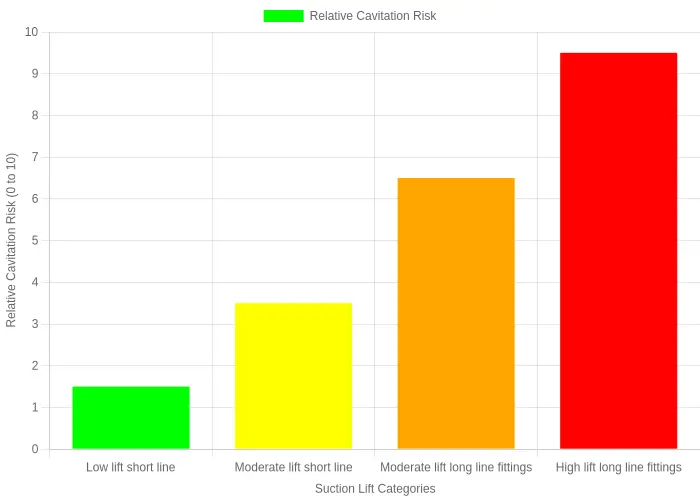
The chart is a general comparison rather than a reading from one real plant, but it captures a pattern most CIP designers recognize. Moving left to right, two things happen at once: static suction lift climbs and line losses grow with longer pipe runs, elbows, and fittings. Relative cavitation risk rises steeply as a result, shown here as an NPSH margin deficit.
Reading the Scenarios
| Suction Lift Scenario | Relative Cavitation Risk | What It Means on the Floor |
|---|---|---|
| Low lift, short line | 1.5 (Low) | Positive NPSH margin, pump runs quietly |
| Moderate lift, short line | 3.5 (Guarded) | Still safe, but margin starts to shrink |
| Moderate lift, long line + fittings | 6.5 (Elevated) | NPSH margin thinning, watch for early warning signs |
| High lift, long line + fittings | 9.5 (High) | Margin deficit, cavitation likely without changes |
Why the curve bends the way it does
The curve climbs fastest on the right, where lift and line losses stack. Trimming an impeller changes where the pump operates on its curve, but it cannot create available NPSH the suction side never supplied. If the inlet piping is starving the pump, a smaller impeller moves the failure point rather than removing it.
The reliable fixes are on the suction side: raise the supply tank, shorten the run, enlarge the inlet pipe, use fewer bends, or lower the wash temperature. Do those and the margin recovers across the scenarios. Chase an impeller trim instead and the symptom may ease while the cause stays.
Operational Indicators of CIP Pump Cavitation in Food Plants
By the time a clean-in-place circuit “fails,” the problem is usually months old. CIP pump cavitation rarely arrives as one dramatic breakdown; it shows up first as a cluster of small, repeatable anomalies.
On the line, the signs are:
- Flow-rate fluctuation. The flow meter swings even though valves, recipes, and setpoints are unchanged, so output varies from run to run.
- Pump noise and vibration. A gravelly, crackling rattle replaces the smooth hum, and vibration climbs, often worst near the suction inlet.
- Pressure gauge instability. The discharge needle trembles or drops in rapid pulses instead of holding steady.
- Reduced cleaning effectiveness. Pulsing flow and pressure make spray balls under-deliver, and swab results or visual checks show residual soil and chemical streaks.
- Accelerated impeller wear. Repeated bubble collapse pits the impeller, eroding performance over time.
Separating suction-limited cavitation from an impeller capacity problem
The signatures overlap, which is why the two problems get confused. One controlled test separates them:
| Symptom | Suction-limited cavitation | True impeller capacity shortfall |
|---|---|---|
| Response to raised suction level (flooded suction, shorter lift) | Flow and pressure recover sharply | Almost no change |
| Pump sound | Crackling, erratic, gravelly | Steady but labored |
| Gauge behavior | Rapid needle flutter | Smooth, low, stable |
| Root-cause pointer | NPSH available too low | Impeller trim or wear |
| Correct fix | Re-size suction lift, pipe, and NPSH margin | Trim or replace impeller |
Rule of thumb: if throttling the discharge does not steady the pump but raising the suction level does, you are fighting suction lift sizing, not impeller capacity.
When flow flickers, the pump grumbles, the gauge trembles, cleaning slips, and the impeller erodes at once, the trail points upstream to suction lift sizing.
FAQ: CIP Pump Cavitation and Suction Lift Sizing in Food Plants
Does trimming the impeller ever help with CIP pump cavitation?
Impeller trim rarely solves CIP pump cavitation because it works on the discharge side, not the suction-side limit that causes the problem. Trimming lowers head and flow but does not raise the Net Positive Suction Head Available (NPSHa), so a pump already starved at the inlet keeps cavitating. A trim can reduce the pump’s required NPSH (NPSHr) slightly, but that gain is usually too small to correct a fundamental suction lift deficiency in a food plant. Treat proper suction lift sizing as the primary remedy, not trim.
What is a safe NPSH margin for CIP pumps?
A practical rule is to keep NPSHa at least 1 meter above the pump’s NPSHr, and 1.5 to 2 meters is safer for CIP service. CIP fluids run hot, which narrows the available margin quickly, so the extra buffer guards against flashing. Many food plant engineers target a 1.1 to 1.5 safety factor on NPSHr for detergent and rinse cycles. Confirm the margin at the highest expected fluid temperature and flow rate.
How does fluid temperature affect suction lift sizing?
Higher fluid temperatures raise vapor pressure, which reduces NPSHa and shrinks the maximum allowable suction lift. CIP solutions are frequently heated to 60-80 degrees C, so suction lift sizing has to be calculated at the hottest temperature the pump will see, not at ambient. Skipping this is one of the most common reasons CIP pump cavitation appears only during hot wash cycles. Derate the allowable lift as temperature climbs.
Can increasing suction line diameter prevent CIP pump cavitation?
A larger suction line lowers friction losses and improves NPSHa, so it often does reduce CIP pump cavitation. Pipe diameter alone will not fix a system where static suction lift, fittings, or a partially blocked strainer dominate the losses. Suction lift sizing combines diameter, length, fittings, and fluid properties into one NPSHa calculation. Enlarging the line helps, but it should follow the calculation, not replace it.
When should suction lift sizing be re-evaluated?
Re-evaluate suction lift sizing whenever you change pump speed, alter CIP chemical concentration or temperature, relocate or raise a tank, or modify the suction piping layout. Revisit it after any persistent cavitation event, since the original design assumptions may no longer hold in the food plant. A regular review during scheduled maintenance keeps the pump operating safely across all cleaning recipes. Treat it as a living calculation, not a one-time task.
For broader context on how production equipment and cleaning practices shape food plant operations, keep your process documentation current.
Fix the suction before you touch the impeller
When a CIP pump cavitates, suction lift sizing is almost always the root cause, and impeller trim is almost never the cure. Trimming reshapes the pump curve but does nothing to raise the pressure at the suction eye. If the net positive suction head available (NPSHa) falls below the required value (NPSHr), the pump cavitates no matter how precisely the impeller is cut. Get the suction side right and the rest of the system becomes far more forgiving.
A Practical Action Sequence for Engineers
Work through these in order, and resist jumping to the last one.
| Step | Action | Why It Comes Here |
|---|---|---|
| 1 | Verify fluid properties | Vapor pressure, viscosity, temperature, and solids content define the real duty point. CIP fluids change with concentration and heat. |
| 2 | Calculate NPSHa against NPSHr | Compare the system’s available head with the pump’s required head, and hold a genuine safety margin. |
| 3 | Review suction line layout and losses | Long runs, elbows, strainers, and undersized piping quietly consume the available margin. |
| 4 | Confirm the pump operates within its NPSH margin | Validate the duty point across the full CIP cycle, not only the design case. |
| 5 | Consider impeller trim | Adjust the impeller only once the suction side is proven stable. |
Each step depends on the one before it. Trimming before the suction side is verified hides the symptom and leaves the cause in place.
The Bottom Line
Suction lift sizing is the foundation; impeller trim is a fine-tuning tool. Follow that order and a recurring cavitation problem becomes a measured, solved one.